

Quantum Model of the Universe: 2,000-Page Three-Volume Physics Study Released
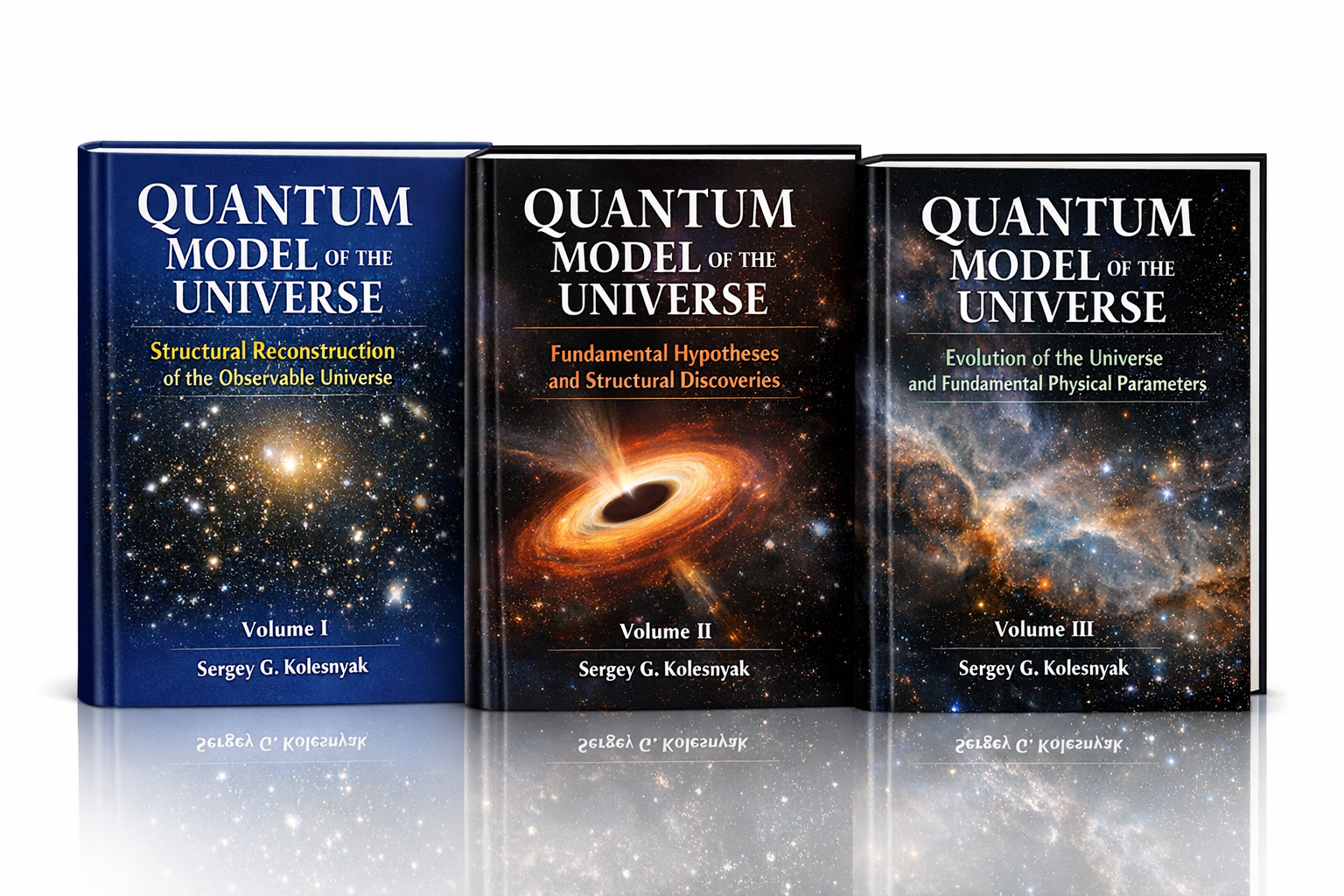
The three-volume research series “Quantum Model of the Universe (QMU)” by Sergey G. Kolesnyak explores the structural foundations of modern physics, from particle microphysics to cosmological evolution.

Left: full-sky map of the cosmic microwave background measured by the Planck mission, revealing temperature fluctuations in the early Universe. Right: deep-field image of distant galaxies observed by the James Webb Space Telescope.
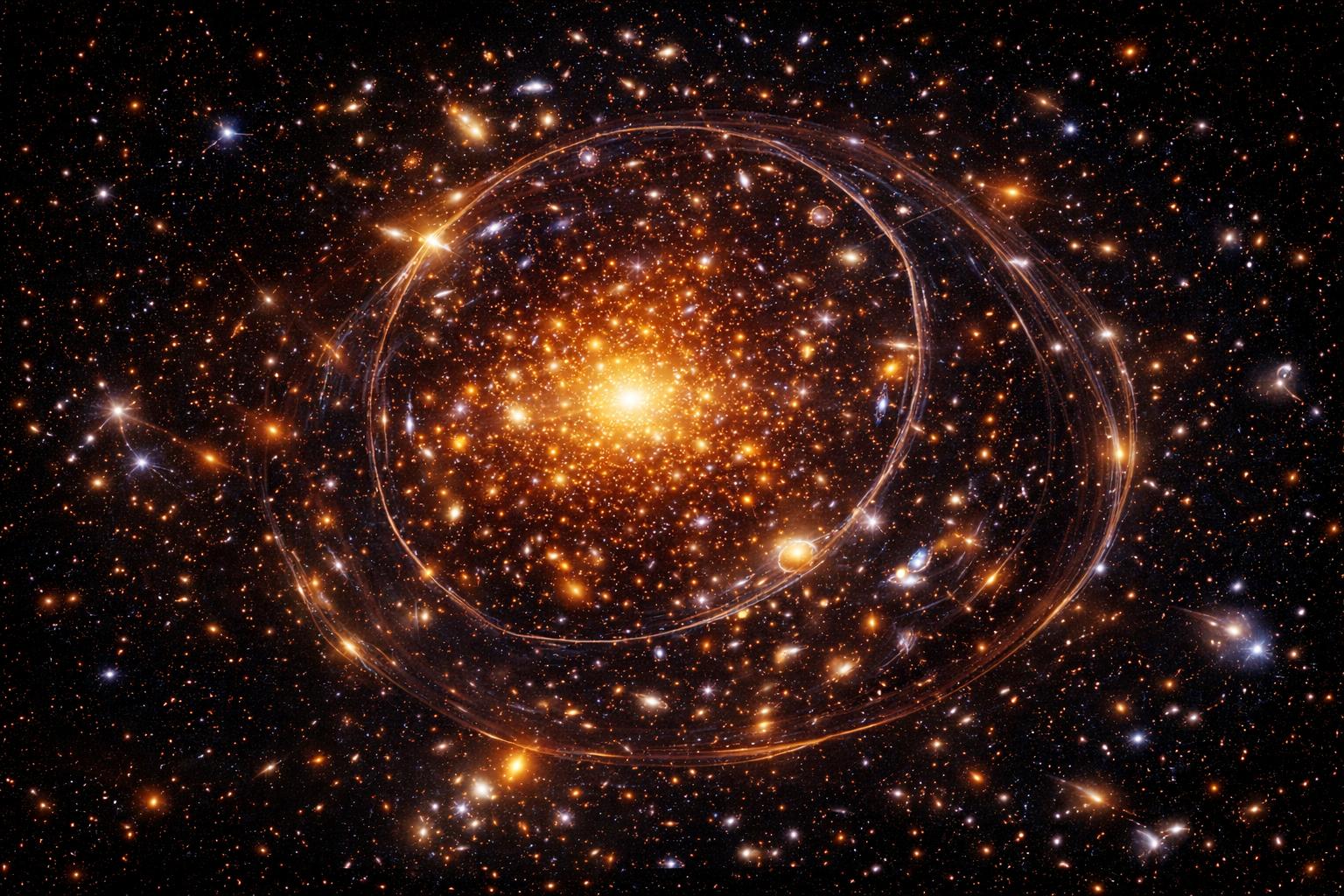
Gravitational lensing produced by a massive galaxy cluster, where the cluster’s gravity bends and magnifies light from distant background galaxies. Image Credit: NASA / ESA / Hubble Space Telescope
A 2,000+ page research project examining the structural foundations of modern physics, linking quantum theory, gravity and cosmology.
The study addresses one of the central challenges of modern science: the search for a coherent description capable of reconciling quantum physics with gravitation. This problem has occupied physicists for more than a century and remains one of the most profound unresolved questions in fundamental theory. Its origins date back to the early twentieth century, when quantum theory and general relativity were established. Already then, Albert Einstein sought to construct a unified field theory capable of describing fundamental interactions within a single mathematical framework.
Throughout the twentieth and early twenty-first centuries, many influential physicists engaged with this problem, including Max Planck, Niels Bohr, Werner Heisenberg, Paul Dirac, Richard Feynman, Steven Weinberg, Abdus Salam, Sheldon Glashow, Stephen Hawking, and Roger Penrose. Despite extraordinary scientific progress, a fully consistent conceptual framework describing the fundamental structure of the Universe remains an open subject of research.
The monograph “Quantum Model of the Universe” proposes a structural perspective on modern physics, treating quantum theory, gravitation, and cosmology as interconnected levels of description within a unified physical reality. The project suggests that persistent problems in contemporary physics — including the nature of vacuum energy, cosmic acceleration, and the relationship between microphysical processes and cosmological structure — may be analyzed through structural constraints determining the admissible architecture of physical theories.
Within this framework, physical laws are interpreted not merely as isolated equations but as elements of a broader structure linking fundamental symmetries, vacuum properties, and the observable dynamics of the Universe. This structural approach allows different theoretical frameworks of modern physics to be examined together within a single cosmological perspective and highlights possible connections between microphysical processes and large-scale cosmic evolution.
The Three-Volume Research Architecture
The Quantum Model of the Universe series is organized as a three-volume investigation forming a unified conceptual research system. Each volume addresses a distinct level of analysis within the broader structure of modern physics and cosmology, moving from empirical observations toward increasingly general structural principles governing the physical description of the Universe.
Volume I — Structural Reconstruction of the Observable Universe
DOI: https://doi.org/10.5281/zenodo.18900572
The first volume establishes the empirical and methodological foundation of the project. It presents a systematic analysis of the observable architecture of the Universe and the empirical constraints any consistent physical theory must satisfy.
The work examines results from high-energy physics experiments, collider data, observations of the cosmic microwave background, and major astronomical surveys, with attention to relationships between microphysical properties of matter and the large-scale structure of the cosmos.
Volume II — Fundamental Hypotheses and Structural Discoveries
DOI: https://doi.org/10.5281/zenodo.18769967
The second volume focuses on conceptual and theoretical foundations of modern physics. It analyzes major theoretical frameworks developed over the past century and a half, including quantum field theory, relativistic gravitation, cosmology, and modern geometric and informational approaches to physical description.
The study examines structural assumptions embedded in fundamental equations and evaluates their compatibility within a unified cosmological framework, highlighting how different theoretical approaches may coexist within a broader structural interpretation of physical reality.
Volume III — Evolution of the Universe and Fundamental Physical Parameters
DOI: https://doi.org/10.5281/zenodo.18818028
The third volume investigates the role of fundamental constants and global parameters in the dynamical architecture of the Universe. It examines possible evolution of fundamental constants and the broader system of parameters characterizing matter, interactions, and cosmological dynamics.
Special attention is given to relationships between microphysical processes, vacuum properties, and the large-scale structure of the Universe, and to how cosmological observations constrain admissible values of fundamental parameters.
Scientific Context and Open Research Program
According to the author, the Quantum Model of the Universe project explores the deeper structural logic underlying modern physics and draws upon several disciplines including theoretical physics, cosmology, quantum field theory, astrophysics, mathematics, and complex systems research.
“Modern science has achieved remarkable success in experimental studies of the Universe — from precise measurements of the cosmic microwave background by the Planck mission to gravitational-wave detection by LIGO and observations of the early Universe by the James Webb Space Telescope,” Kolesnyak said.
“At the same time, international research programs such as DESI and experiments at the Large Hadron Collider have greatly expanded our understanding of both the microphysical structure of matter and cosmic evolution. These advances also raise new fundamental questions. The QMU project attempts to interpret these results within a broader structural perspective on modern physics.”
The author emphasizes that the project does not aim to introduce a new particle or modify existing equations, but to analyze how current theoretical frameworks may be interpreted together within a coherent structural perspective capable of connecting microphysics, cosmology, and the geometry of space-time.
The monographs are available in open access through the scientific repository Zenodo, providing global accessibility for researchers and facilitating further scientific discussion and collaboration.
The author expresses gratitude to CERN and the Large Hadron Collider collaborations for experimental contributions to particle physics, as well as to NASA missions including the Hubble Space Telescope and the James Webb Space Telescope. Recognition is also given to cosmological survey programs such as DESI and to international observatories whose open data contributed to the empirical foundations of the study.
The work represents an independent analytical reconstruction of accumulated scientific knowledge. All interpretations and conclusions belong solely to the author and do not represent official positions of the organizations whose scientific results are discussed.
Alex Davidson
World Academy Awards
email us here
Legal Disclaimer:
EIN Presswire provides this news content "as is" without warranty of any kind. We do not accept any responsibility or liability for the accuracy, content, images, videos, licenses, completeness, legality, or reliability of the information contained in this article. If you have any complaints or copyright issues related to this article, kindly contact the author above.
