

Encoder Market Growth Story From USD 4.12 Billion to USD 7.96 Billion at 7.60% CAGR
Encoder Market
Encoder Market Size, Share and Research Report By Type (Rotary Encoder, Linear Encoder, Incremental Encoder, Absolute Encoder), By Technology (Optical Encoder)
The Encoder Market is experiencing significant growth owing to increasing automation across industrial, automotive, and robotics applications requiring precise motion control and positioning.”
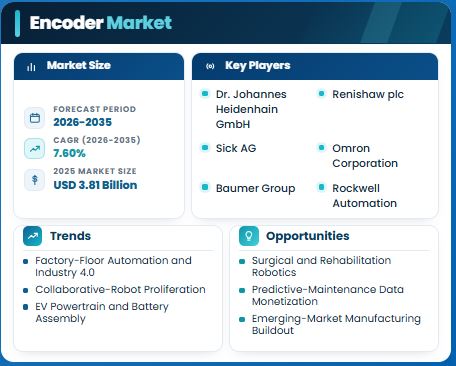
NEW YORK,, NY, UNITED STATES, June 30, 2026 /EINPresswire.com/ -- The Encoder market reached a valuation of USD 3.81 billion in 2025 and is projected to climb from USD 4.12 billion in 2026 to USD 7.96 billion by 2035, registering a compound annual growth rate of 7.60% across the forecast window. Encoders electromechanical transducers that convert mechanical position or motion into electrical signals for feedback and control in automated systems are the precision sensing backbone of modern industrial automation, collaborative robotics, EV powertrain assembly, semiconductor lithography, and medical device manufacturing. — Market Research Future (MRFR)
Sustained investment in factory-floor automation underpinned by national initiatives including China’s “Made in China 2025” extension roadmap, Germany’s Industrie 4.0 strategy, and global industrial automation spending exceeding USD 265 billion in 2024 continues to drive demand for high-resolution position feedback across discrete and process manufacturing at a pace that firmly anchors the encoder market’s decade-long growth trajectory.
A decisive technology shift is simultaneously reshaping the encoder market’s competitive landscape and raising average selling prices. Legacy incremental encoders that lose position reference on power loss are giving way to absolute encoder designs that eliminate re-homing sequences after power interruptions, cutting mean setup time by up to 40% on CNC platforms.
Parallel to this, integrated motor-encoder modules pioneered in Japan and now adopted by European servo-drive houses are consolidating two discrete components into single compact units, trimming assembly labor and improving mean time between failures across high-density robotic installations. Capital commitments in rotary optical encoders for servo motors alone exceeded USD 320 million in 2024 across major OEM programs, validating the structural upgrade cycle that is elevating technical content per encoder unit and reshaping competitive dynamics among the market’s leading precision-sensing specialists.
Get Full PDF Sample Copy of Report: (Including Full TOC, List of Tables & Figures, Chart) @
https://www.marketresearchfuture.com/sample_request/42348
➤ How Significant Is the Encoder Market’s Growth?
The encoder market’s trajectory from USD 3.81 billion in 2025 to a projected USD 7.96 billion by 2035 represents more than a doubling over the forecast decade, underpinned by the convergence of industrial automation capital expenditure cycles, collaborative robot proliferation, EV powertrain manufacturing expansion, and tightening functional-safety regulation that collectively mandate higher encoder content per automated production cell.
Rotary encoders accounted for 67.9% of encoder market revenue in 2025, driven by their ubiquity in servo-motor and robotics applications, while linear encoders are expanding at the fastest pace through 2035, propelled by demand in semiconductor lithography and precision coordinate-measuring machines.
Optical encoder systems led with a 55.4% technology share in 2025, reflecting established dominance in high-resolution industrial feedback, while magnetic encoders are registering the strongest growth rate, benefiting from lower cost and superior contamination tolerance in harsh industrial environments.
Incremental encoders controlled 57.3% of the market by output signal type in 2025, while absolute encoders are gaining share at the fastest CAGR as safety-critical applications mandate position memory through power cycles. Industrial automation represented 41.2% of end-user demand in 2025, while medical device manufacturing is the fastest-growing end-use vertical through 2035, driven by surgical robotics and precision therapeutic device manufacturing.
➤ What Does the Future Hold for the Encoder Market?
Factory-floor automation and Industry 4.0 investment represent the encoder market’s most durable structural demand driver, contributing approximately +1.9 percentage points to the CAGR the highest driver impact across all demand catalysts. Germany’s BMBF allocated EUR 470 million to next-generation production research through 2027, and China’s Ministry of Industry earmarked CNY 58 billion for smart-factory demonstration zones both programs directly increasing encoder attach rates per production cell.
Position-feedback components captured approximately 3.8% of the USD 265 billion global industrial automation spending in 2024, and as robot density per 10,000 manufacturing employees continues rising globally from 151 units in 2023 toward an estimated 220+ by 2028 per the International Federation of Robotics encoder unit volumes scale commensurately.
Collaborative robot proliferation is driving a decisive shift toward higher-specification absolute encoder architectures. The installed base of cobots surpassed 750,000 units globally in 2024, with each unit requiring two to seven encoders depending on axis count and payload class. Unlike traditional industrial robots housed behind safety cages, cobots operate in shared human-machine workspaces where real-time torque and position feedback must meet ISO/TS 15066 force-limiting thresholds.
This safety requirement pushes cobot OEMs toward higher-resolution absolute encoders, accelerating the encoder market’s transition away from cost-driven incremental units and establishing a sustained mix-shift toward premium product tiers. The European Machinery Regulation 2023/1230, replacing the legacy Machinery Directive from January 2027, will further expand the scope of functional-safety encoder adoption and create incremental per-axis revenue across the encoder market.
EV powertrain and battery gigafactory expansion is establishing automotive as one of the encoder market’s fastest-growing commercial application verticals.
Electric vehicle production surpassed 18 million units in 2024, and battery gigafactory capacity under construction exceeds 5 TWh globally. Encoder modules sit at the core of electrode-coating, cell-stacking, and module-assembly stages where positioning tolerances of ±5 µm determine yield rates and scrap costs. As automakers shift toward 800-volt architectures requiring tighter winding precision in traction motors, encoder specifications are tightening correspondingly a dynamic that benefits optical and inductive encoder product lines while driving above-market revenue growth across automotive end-use segments through 2035.
➤ Who Are the Key Players in the Encoder Market?
The encoder market is served by a concentrated group of precision sensing and measurement technology specialists with deep application engineering expertise across industrial automation, robotics, and precision manufacturing. MRFR identifies the following key participants:
Dr. Johannes Heidenhain GmbH (Germany) - the global market leader in precision linear and rotary optical encoders, providing high-resolution position measurement solutions for machine tool CNC systems, semiconductor lithography stages, and precision coordinate-measuring machines, with encoder accuracy specifications reaching sub-nanometer resolution in flagship product lines.
Renishaw plc (United Kingdom) - a global precision measurement and encoder technology leader, providing optical and magnetic encoder systems for machine tools, additive manufacturing, healthcare, and scientific instrumentation, with RESOLUTE absolute optical encoders offering industry-leading resolution of up to 1 nm and speed capability exceeding 100 m/s.
Sick AG (Germany) - a leading industrial sensor and encoder manufacturer providing rotary and linear encoders across a broad performance range for factory automation, logistics, and robotics applications, with HIPERFACE DSL integrated motor-feedback interface encoders widely adopted by European servo-drive OEMs.
Omron Corporation (Japan) - a major industrial automation and sensing technology company providing rotary incremental and absolute encoders for factory automation, robotics, and motion control applications, with comprehensive encoder portfolios integrated within its broader servo system and programmable controller ecosystem.
Baumer Group (Switzerland) - a precision sensing and encoder technology specialist providing rotary, linear, and angular encoders for industrial automation, medical devices, and food and beverage processing applications, with particular strength in hygienic-design encoder variants for washdown-rated environments.
Rockwell Automation, Inc. (United States) - a global industrial automation leader integrating encoder and position feedback products within its Allen-Bradley servo drive, motion control, and safety system portfolios, serving discrete manufacturing, automotive, and oil and gas automation applications across North America and global markets.
Competitive dynamics in the encoder market are increasingly shaped by the transition from incremental to absolute encoder architectures, the integration of edge-AI diagnostic layers and IIoT connectivity within encoder platforms, and the intensifying price competition from commoditized magnetic IC manufacturers in Shenzhen and Suzhou that is pressuring premium optical encoder vendors to differentiate on accuracy, functional-safety certification, and application engineering support.
➤ What Are the Emerging Trends in the Encoder Market?
Several transformational trends are redefining the encoder market’s evolution through 2035:
Absolute Encoder Migration from Incremental Designs: The transition from incremental to absolute encoder architectures eliminating power-loss re-homing sequences that cut CNC platform mean setup time by up to 40% is accelerating across industrial automation, robotics, and safety-critical applications. IEC 61508 SIL-3 and ISO 13849 PLe functional-safety mandates are further accelerating this migration by requiring redundant position feedback in an expanding range of machinery categories.
Collaborative Robot Proliferation Driving Premium Encoder Demand: The 750,000+ unit global cobot installed base each requiring two to seven encoders meeting ISO/TS 15066 force-limiting performance standards is establishing collaborative robotics as a sustained, premium-specification demand category for high-resolution absolute encoders, with cobot unit shipments projected to maintain double-digit annual growth rates through 2030.
EV Powertrain & Battery Gigafactory Encoder Integration: With EV production surpassing 18 million units in 2024 and battery gigafactory capacity under construction exceeding 5 TWh globally, electrode-coating and cell-assembly stages requiring ±5 µm positioning tolerances are creating a structurally new, high-volume automotive encoder demand category that is reshaping product roadmaps at leading encoder OEMs.
Edge-AI Diagnostic & Predictive Maintenance Integration: Encoder manufacturers are embedding condition-monitoring sensors, vibration analysis algorithms, and IIoT connectivity within encoder housings, transforming position feedback components into intelligent data-generating assets. Predictive maintenance data monetization delivered through encoder-manufacturer SaaS platforms represents an emerging recurring revenue stream that supplements traditional hardware sales models.
Surgical & Rehabilitation Robotics Expansion: Medical device manufacturing is advancing as the fastest-growing end-use vertical for the encoder market through 2035, driven by surgical robot joint articulation systems, rehabilitation exoskeleton position feedback, and radiation therapy treatment head positioning encoders that demand extreme accuracy, miniaturization, and biocompatibility-compliant encoder housings.
Emerging-Market Manufacturing Buildout: India’s Production-Linked Incentive scheme, Vietnam’s electronics manufacturing cluster expansion, and Mexico’s nearshoring-driven automotive and aerospace component production ramp are creating new geographic demand centers for industrial encoders, extending the market’s addressable customer base beyond the established demand concentration in Germany, Japan, China, and the United States.
Get access to the full description of the report @
https://www.marketresearchfuture.com/reports/encoder-market-42348
➤ How Is the Encoder Market Segmented?
The encoder market report provides a comprehensive segmentation framework:
By Type: Rotary Encoder, Linear Encoder, Incremental Encoder, Absolute Encoder
By Technology: Optical Encoder, Magnetic Encoder, Capacitive Encoder, Inductive Encoder
By Application: Industrial Automation, Consumer Electronics, Automotive, Robotics
By End Use: Manufacturing, Aerospace, Healthcare, Telecommunications
By Region: North America, Europe, Asia-Pacific, South America, Middle East and Africa
➤ What Are the Regional Insights from the Encoder Market?
Asia-Pacific commands roughly 37.7% of global encoder market revenue in 2025 and simultaneously posts the highest regional growth CAGR through 2035, driven by China’s CNY 58 billion smart-factory demonstration zone investment, Japan’s world-leading robot density and servo system manufacturing base anchored by Omron and Fanuc, and South Korea’s semiconductor fab expansion generating sustained demand for sub-nanometer linear encoder systems.
India’s Production-Linked Incentive scheme for electronics and advanced manufacturing is establishing the subcontinent as an emerging encoder demand center, while Vietnam and Thailand are adding incremental demand as multinational OEMs expand production footprints across Southeast Asia.
North America is the second-largest regional market, anchored by automotive electrification retooling across Michigan’s motor city manufacturing corridor, high-volume logistics automation expansion along the Eastern Seaboard, and semiconductor fab encoder demand generated by CHIPS Act-funded domestic fabrication facility investments. Rockwell Automation’s established North American channel presence and the region’s strong collaborative robot adoption curve driven by persistent manufacturing labor shortages are reinforcing demand for premium absolute and safety-rated encoder products across US and Canadian industrial procurement programs.
Europe holds a premium position in high-specification optical encoder products, home to the market’s two most technically advanced encoder OEMs Heidenhain and Renishaw as well as Sick AG and Baumer Group.
Germany’s EUR 470 million BMBF next-generation production research allocation, the European Machinery Regulation 2023/1230’s expanded functional-safety scope effective January 2027, and the continent’s high-precision machine tool and aerospace manufacturing base are sustaining Europe’s position as the global encoder market’s premium product demand and innovation center, even as competitive pressure from cost-optimized magnetic IC manufacturers in China erodes entry-level market share.
South America and the Middle East & Africa represent emerging growth markets for the encoder market, with adoption driven by expanding automotive component manufacturing in Brazil and Mexico, growing industrial automation investment in the Gulf Cooperation Council states, and the gradual buildout of electronics and semiconductor assembly capacity across these regions.
While currently accounting for smaller shares of global revenue, rising foreign direct investment in manufacturing infrastructure, growing robot density in Brazilian and Mexican automotive plants, and government-backed industrial modernization programs are expected to support above-average encoder market growth rates through 2035.
➤➤➤ Industry Analysis Reports by Market Research Future:
Bancassurance Market-
https://www.marketresearchfuture.com/reports/bancassurance-market-23854
Commercial Payment Cards Market-
https://www.marketresearchfuture.com/reports/commercial-payment-cards-market-23869
Virtual Cards Market-
https://www.marketresearchfuture.com/reports/virtual-cards-market-23880
Aviation Insurance Market-
https://www.marketresearchfuture.com/reports/aviation-insurance-market-23897
Private Banking Market-
https://www.marketresearchfuture.com/reports/private-banking-market-23978
Merchant Cash Advance Market-
https://www.marketresearchfuture.com/reports/merchant-cash-advance-market-24003
Credit Insurance Market-
https://www.marketresearchfuture.com/reports/credit-insurance-market-24055
Smart Tracker Tag Market-
https://www.marketresearchfuture.com/reports/smart-tracker-tag-market-24127
Takaful Market-
https://www.marketresearchfuture.com/reports/takaful-market-24163
Commercial Lending Market-
https://www.marketresearchfuture.com/reports/commercial-lending-market-24325
Sagar Kadam
Market Research Future
+ + +1 628-258-0071
email us here
Visit us on social media:
LinkedIn
Facebook
YouTube
X
Legal Disclaimer:
EIN Presswire provides this news content "as is" without warranty of any kind. We do not accept any responsibility or liability for the accuracy, content, images, videos, licenses, completeness, legality, or reliability of the information contained in this article. If you have any complaints or copyright issues related to this article, kindly contact the author above.
